Memorize 1000 digits of pi
A thousand random digits sounds impossible, and by repetition alone it nearly is. But your memory is superb at one thing: remembering places and the strange things that happen in them. This site turns pi into a walk through a set of pictures, so recalling a digit becomes remembering a scene.
pegs known
pictures with sentences
best recite (digits)
Why it works
Digits are abstract. There is nothing about "65" that your brain wants to hold on to. Images, actions and locations are the opposite: you can probably still picture the layout of your childhood home, years later, without ever having tried to memorize it.
The memory palace (also called the method of loci) uses that. You attach what you want to remember to vivid images placed in a familiar setting, then later "walk" through the setting and read the images back. It is the core technique behind almost every memory-competition record, and it works for ordinary people too, because it relies on a kind of memory everyone already has.
The method, in four layers
1. Rows and pairs
The 1000 digits after "3." are split into 100 rows of 10 digits, and each row into 5 pairs. You never deal with more than one row at a time.
2. A peg word for every pair
Each pair from 00 to 99 has its own fixed peg word, a concrete thing you can picture. The words come from the Major System, where every digit stands for a consonant sound:
Vowels (and w, h, y) count for nothing, so you fill them in to make a word: 1 + 4 is t + r, which gives TIRE; 2 + 8 is n + f, which gives KNIFE. Because the sounds are systematic, a peg you half-forget can be rebuilt from its digits, and a word can always be turned back into its number.
3. A picture for every five rows
A palace is a set of pictures. Each picture holds 5 rows (50 digits), so 20 pictures cover all 1000. The pictures come in a fixed order, so the order of the pictures is the order of the digits.
4. Your sentence for every row
For each row you write one vivid sentence that puts its 5 peg words, in order, into that row's picture. This is the part that makes the memory yours. The site gives you the digits, the pegs and the pictures; you supply the story.
Worked example: row 1
The digits
14 15 92 65 35
become peg words
TIRE · TOWEL · BONE · JAIL · MAIL
placed in the first picture of Villain's Lair
Cracked steps filled with tires. A towel is standing on these holding a large femur bone guarding a jail which is holding a bunch of mailmen inside.
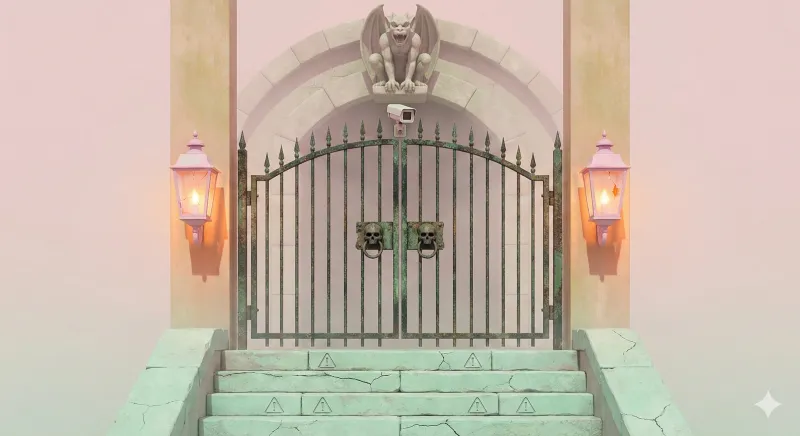
That one sentence holds ten digits. The other four rows of the same picture get their own sentences, each using a different part of the scene, and the next picture picks up at row 6.
Recalling: running it backwards
- Picture the place. Start at the first picture and walk through them in order.
- Replay the scene. In each picture, recall the sentence for each row.
- Read off the pegs. The sentence gives you 5 peg words, in order.
- Turn words into digits. Each peg word converts straight back to its pair. Once the pegs are second nature this is instant.
With practice the middle steps fade and you simply "see" the digits while walking through the palace.
Your path
- Learn the peg wordsOpen Pegs
Drill the 100 pegs until they're instant, from number to word and from word to number. Everything else depends on this.
- Pick a palaceChoose a palace
Choose a set of pictures to hold the digits.
- Write your sentencesOpen Villain's Lair
Open a picture, then write a sentence for each of its 5 rows. Start with the first picture.
- Drill the palacePractice
On the palace's Practice tab: Peg Word Recall shows a picture and asks for each row's pegs; Find the Nth Digit asks for the digit at a position.
- ReviewOpen Training
Look over the digits with their peg words, and spot rows that still need a sentence.
- Test yourselfStart reciting
Type the digits from memory. The heat map at the end shows where you hesitated.
A realistic plan
- First, the pegs. Spend 10–15 minutes a day on Pegs until you can answer every pair without thinking, in both directions. Don't rush this. Slow pegs make everything after them slow.
- Then one picture a day. Write the 5 sentences for one picture (50 digits) and drill it. At that pace the whole palace takes about three weeks.
- Review before you add. Each day, walk through every picture you've already learned before starting a new one. Use Peg Word Recall for this.
- Test regularly. Recite from the start once or twice a week. Where you stumble, go back and improve that row's sentence.
Writing good sentences
- Make it strange. Exaggerated, funny, violent or absurd scenes stick; sensible ones fade.
- Make it move. Things crashing, melting or chasing each other beat things sitting still.
- Use the picture. Anchor each peg to a specific spot in the scene, and move through the picture in a consistent direction.
- Keep the order. The pegs must appear in the same order as the pairs.
- Keep the pegs. Use the peg itself (TIRE, not "wheel"), or you'll decode the wrong digits.
- Fix what doesn't stick. If a row keeps failing in practice, rewrite its sentence. That feedback loop is how the palace gets strong.
Your data
There's no account. Everything you write is saved in this browser only. Use Back up at the top regularly; it downloads a small file. Use Restore (in the ⋯ menu) to load that file on another device or after clearing your browser.